Understanding Absolute Value
The absolute value of a number is its distance from zero. Absolute value equations have the form \( |ax + b| = c \).
How to Solve
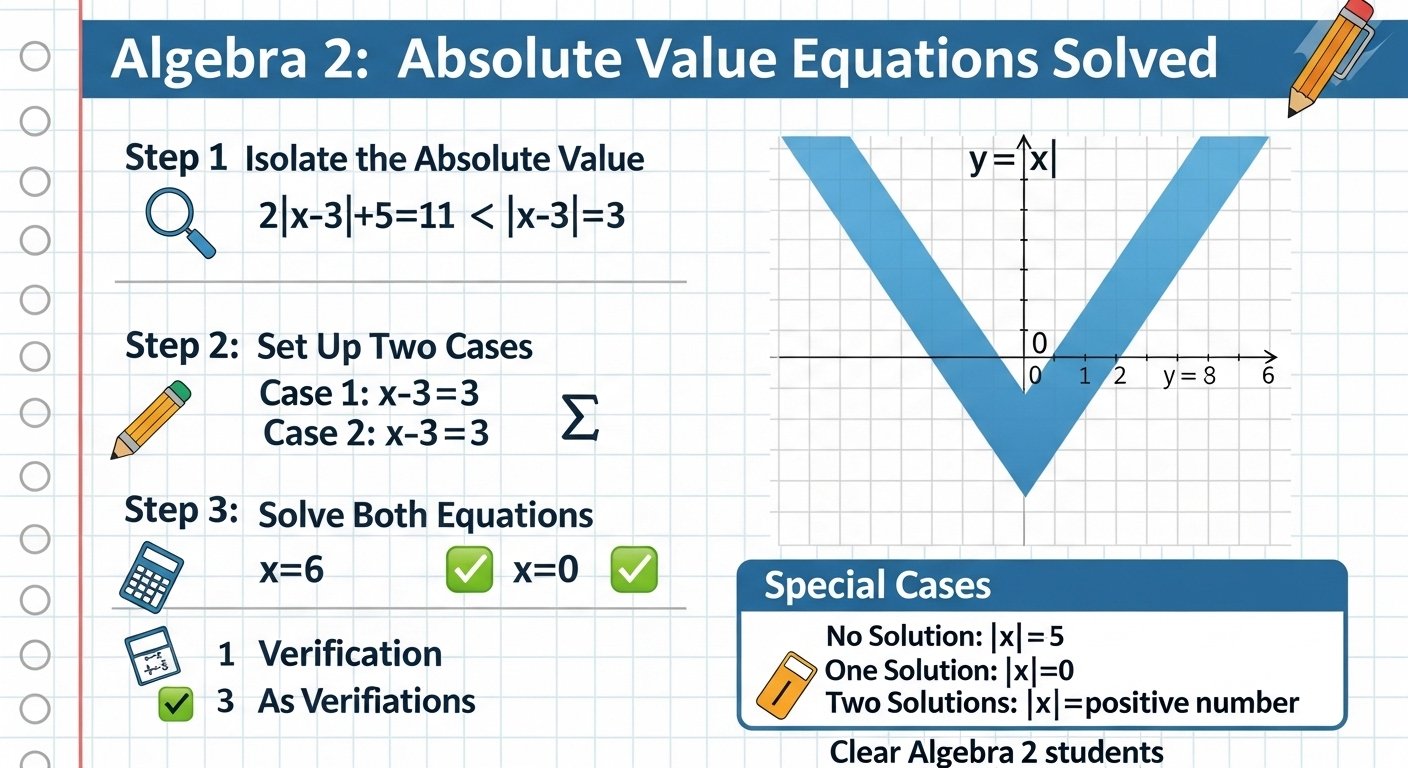
Since absolute value represents distance, \( |A| = c \) means \( A = c \) OR \( A = -c \).
Example: Solve \( |2x - 3| = 7 \)
Case 1: \( 2x - 3 = 7 \) → \( x = 5 \)
Case 2: \( 2x - 3 = -7 \) → \( x = -2 \)
Solutions: \( x = 5 \) or \( x = -2 \)
Special Cases
- If \( c < 0 \): No solution (absolute value cannot be negative)
- If \( c = 0 \): One solution (solve \( ax + b = 0 \))
Try absolute value equations on our Algebra 2 Solver!