What Are Quadratic Equations?
A quadratic equation is any equation that can be written in the form \( ax^2 + bx + c = 0 \), where \( a \neq 0 \). These equations are fundamental in Algebra 2 and appear constantly in math, science, and engineering.
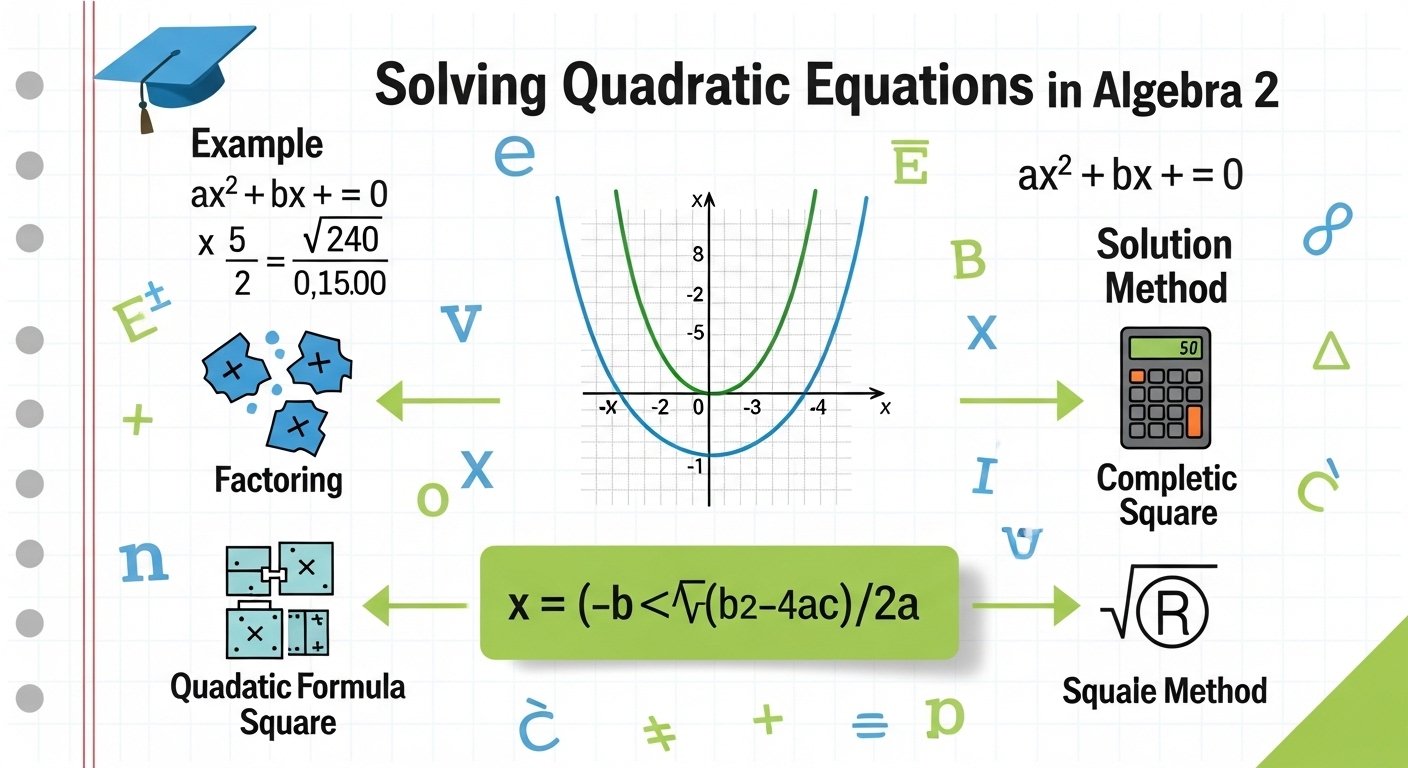
Three Methods for Solving Quadratics
Method 1: Factoring
If the quadratic factors nicely, this is the fastest method.
Example: \( x^2 - 5x + 6 = 0 \)
Factor: \( (x-2)(x-3) = 0 \), so \( x = 2 \) or \( x = 3 \)
Method 2: Quadratic Formula
Works for ALL quadratic equations:
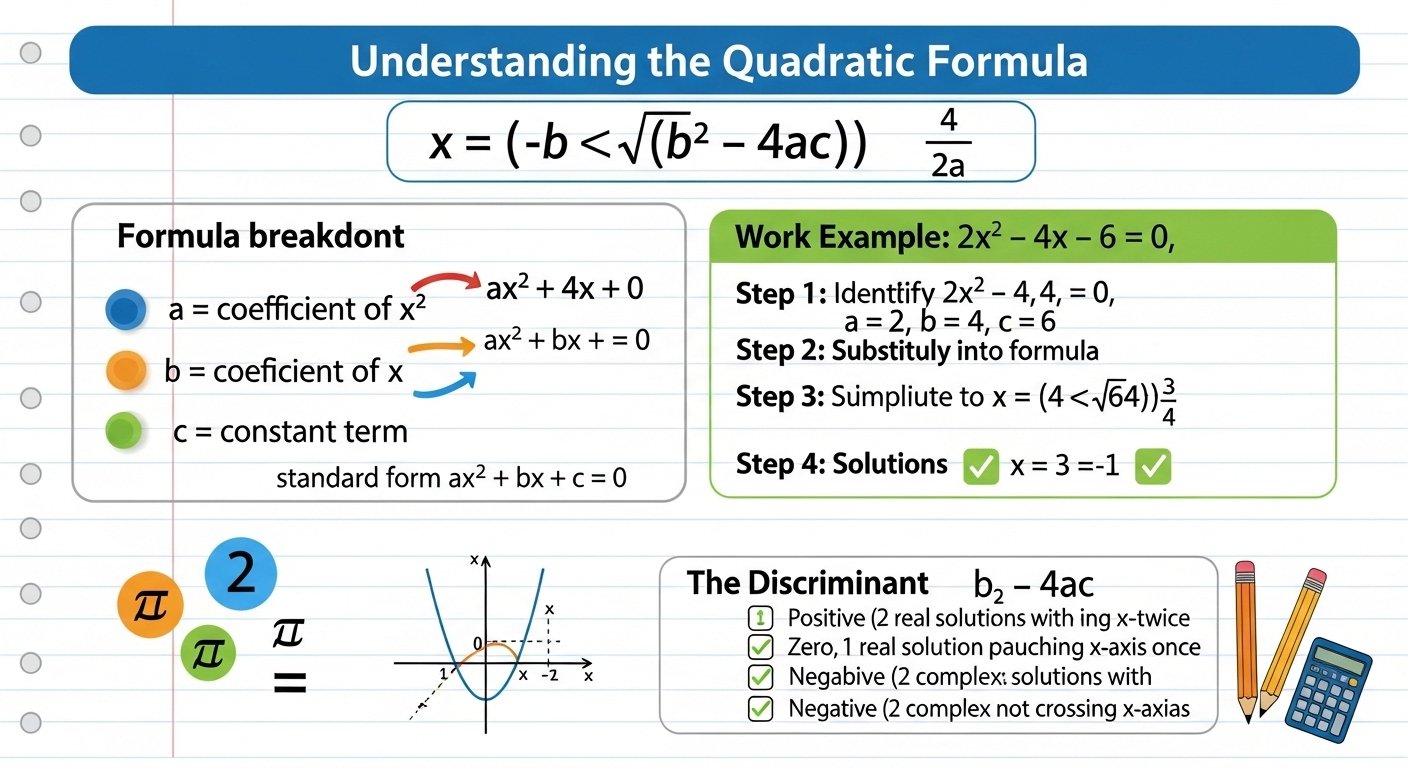
\[ x = \frac{-b \pm \sqrt{b^2 - 4ac}}{2a} \]
Method 3: Completing the Square
Useful for deriving the quadratic formula and solving certain types.
The Discriminant
The discriminant \( \Delta = b^2 - 4ac \) tells you about the solutions:
- \( \Delta > 0 \): Two distinct real solutions
- \( \Delta = 0 \): One repeated real solution
- \( \Delta < 0 \): Two complex (imaginary) solutions
Practice Problems
Try these on our solver:
- \( x^2 + 4x - 12 = 0 \)
- \( 2x^2 - 3x + 1 = 0 \)
- \( x^2 + 1 = 0 \) (complex roots)