What Are Inequalities?
An inequality uses symbols like \( <, >, \leq, \geq \) instead of an equals sign. The solution is a range of values rather than a single number.
Solving Linear Inequalities
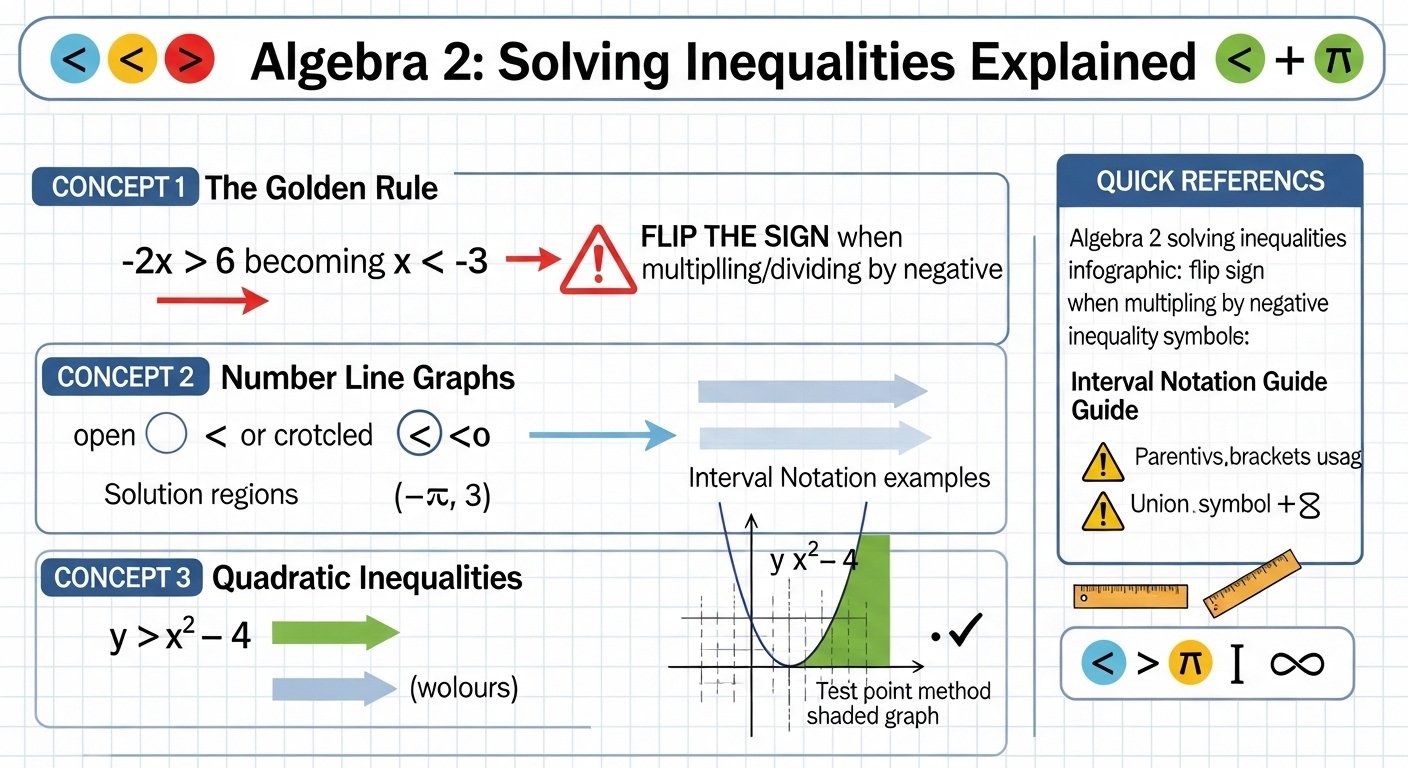
Solve like a linear equation, but flip the inequality sign when multiplying or dividing by a negative number.
Example: Solve \( -3x + 6 > 12 \)
- Subtract 6: \( -3x > 6 \)
- Divide by -3 (flip!): \( x < -2 \)
Solution in interval notation: \( (-\infty, -2) \)
Solving Absolute Value Inequalities
For \( |ax+b| < c \): split into \( -c < ax+b < c \)
For \( |ax+b| > c \): split into \( ax+b > c \) OR \( ax+b < -c \)
Graphing Solutions
Use a number line with open circles for \( < \) and \( > \), and closed circles for \( \leq \) and \( \geq \).
Practice inequalities on our Algebra 2 Solver!