What Are Rational Equations?
A rational equation is an equation that contains one or more fractions with variables in the denominator. For example: \( \frac{2x+1}{x-3} = 5 \).
How to Solve Rational Equations
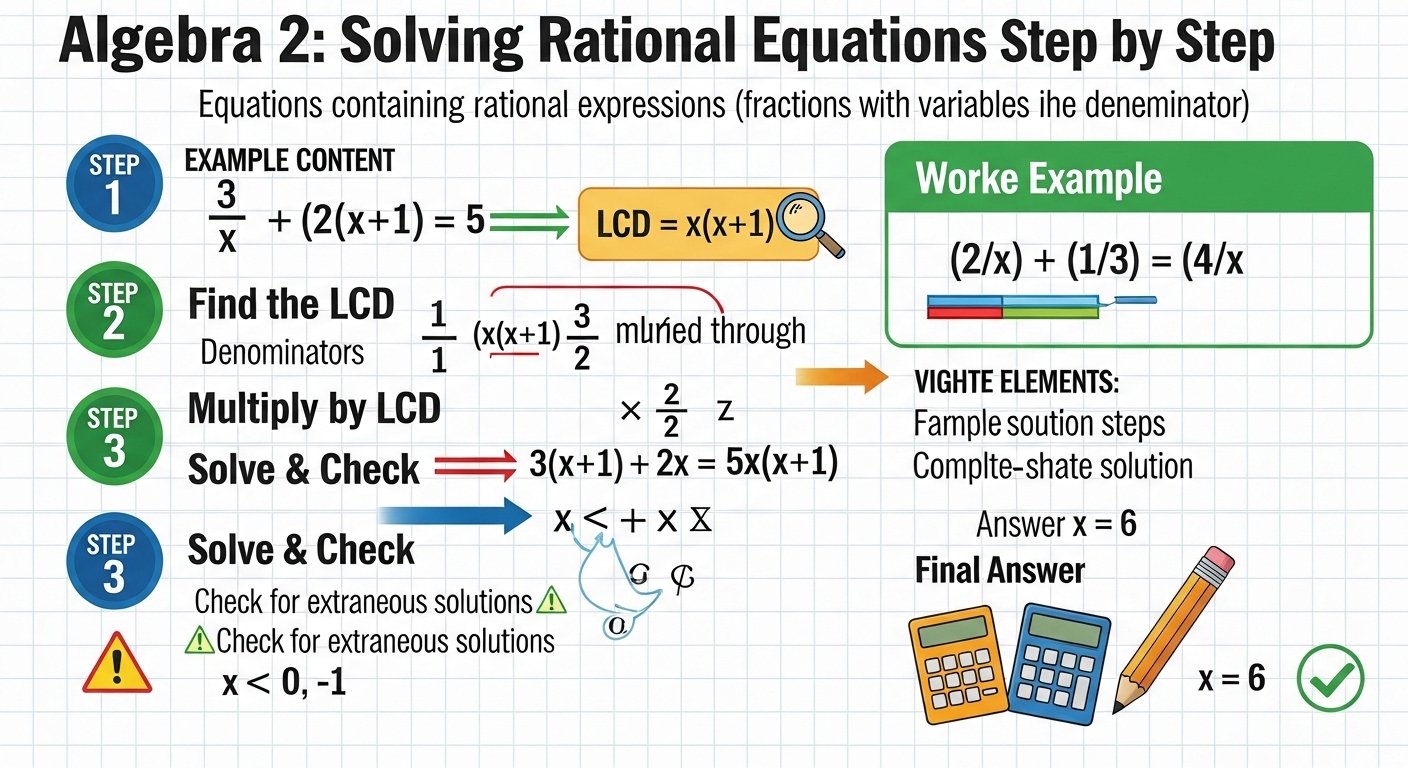
- Find the LCD (Least Common Denominator) of all fractions.
- Multiply every term by the LCD to eliminate fractions.
- Solve the resulting equation (usually linear or quadratic).
- Check for extraneous solutions ΓÇö values that make any denominator zero are not valid.
Example
Solve \( \frac{x+1}{x-2} = 3 \)
- Multiply both sides by \( (x-2) \): \( x + 1 = 3(x-2) \)
- Expand: \( x + 1 = 3x - 6 \)
- Solve: \( -2x = -7 \), so \( x = 3.5 \)
- Check: \( x = 3.5 \) does not make the denominator zero Γ£ô
Common Mistakes
- Forgetting to check for extraneous solutions
- Not multiplying every term by the LCD
Practice
Try solving rational equations on our solver to see step-by-step solutions!