What Are Radical Equations?
A radical equation contains a variable under a radical sign (square root). Example: \( \sqrt{2x+3} = 5 \).
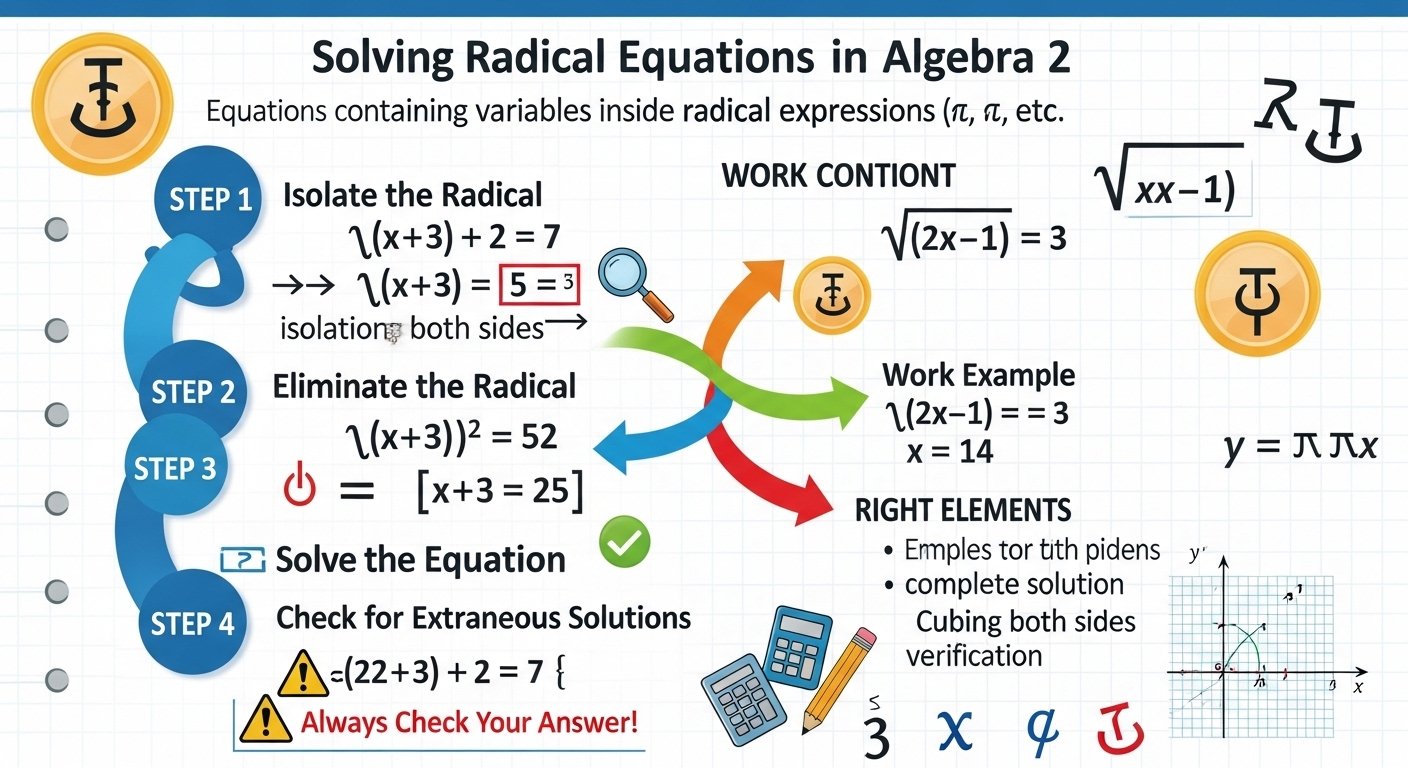
How to Solve Radical Equations
- Isolate the radical on one side of the equation.
- Square both sides to eliminate the radical.
- Solve the resulting equation.
- Check for extraneous solutions ΓÇö squaring can introduce false solutions.
Example
Solve \( \sqrt{2x+3} = 5 \):
- Square both sides: \( 2x + 3 = 25 \)
- Subtract 3: \( 2x = 22 \)
- Divide by 2: \( x = 11 \)
- Check: \( \sqrt{22+3} = \sqrt{25} = 5 \) Γ£ô
Why Check for Extraneous Solutions?
Squaring both sides can create solutions that do not satisfy the original equation. Always substitute back to verify.
Try radical equations on our Algebra 2 Solver!