Introduction
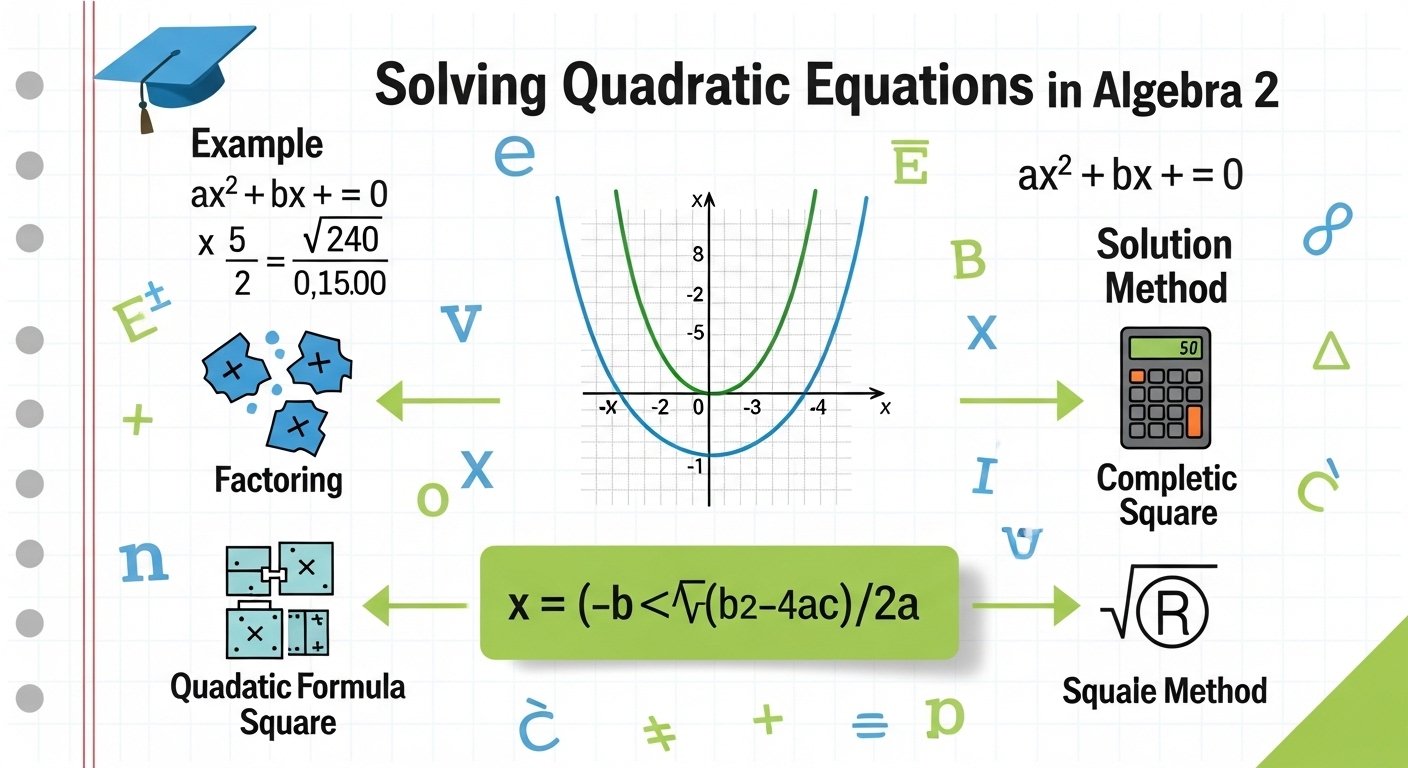
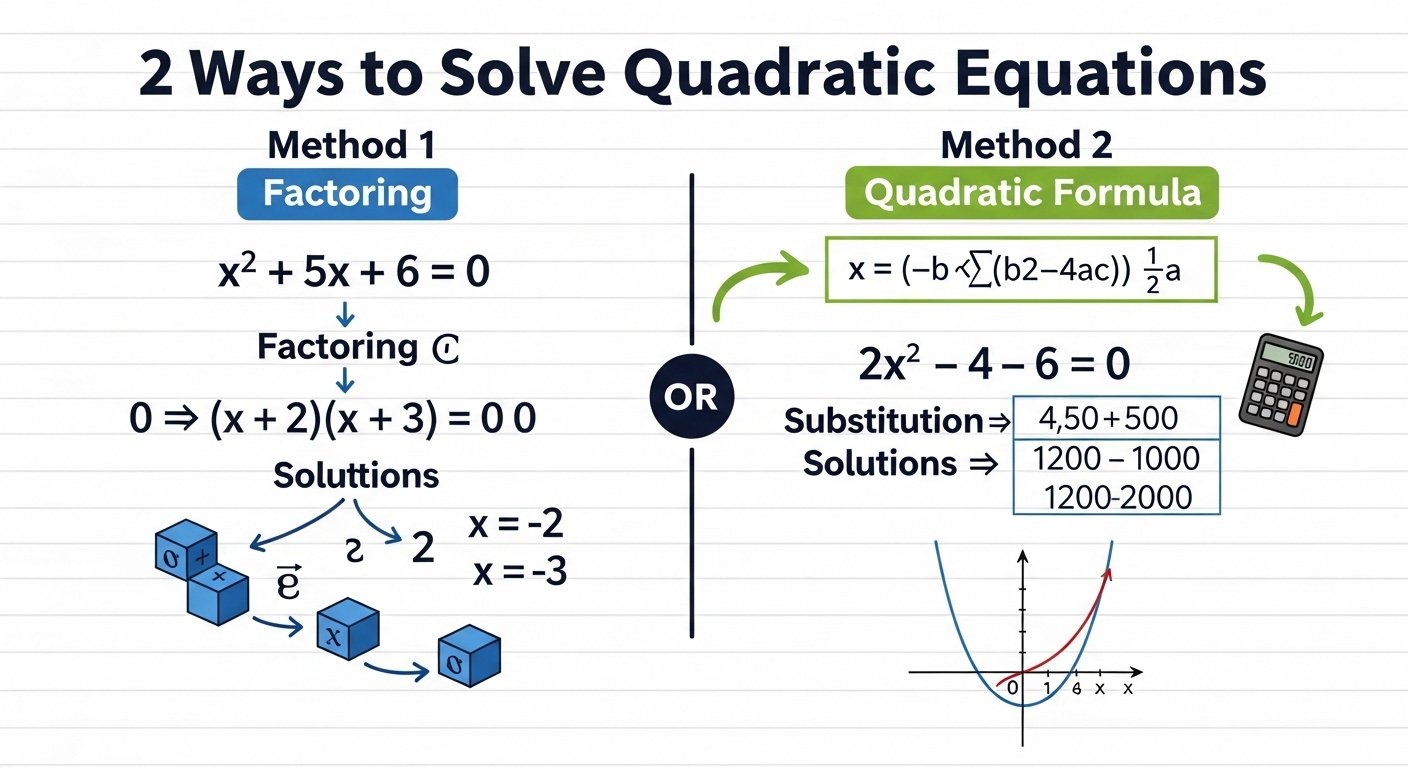
Students often ask: what are the 2 ways to solve quadratic equations that work every time? While there are actually three common methods (factoring, quadratic formula, completing the square), the two most reliable methods are factoring and the quadratic formula.
Way 1: Factoring
Factoring works when you can express \( ax^2 + bx + c \) as a product of two binomials.
Example: \( x^2 + 7x + 12 = 0 \)
Find two numbers that multiply to 12 and add to 7: that is 3 and 4.
\( (x+3)(x+4) = 0 \), so \( x = -3 \) or \( x = -4 \).
Way 2: The Quadratic Formula
When factoring is not possible or obvious, use the quadratic formula:
Example: \( 2x^2 + 3x - 5 = 0 \)
Here \( a=2, b=3, c=-5 \). The discriminant is \( 9 + 40 = 49 \).
\( x = \frac{-3 \pm 7}{4} \), giving \( x = 1 \) or \( x = -2.5 \).
When to Use Which Method
- Use factoring when the equation factors easily with integer roots.
- Use the quadratic formula as your go-to backup ΓÇö it always works.
Try It Yourself
Practice both methods on our Algebra 2 Solver and compare your steps with the solutions!